Navigating the landscape: Understanding the Czech energy market
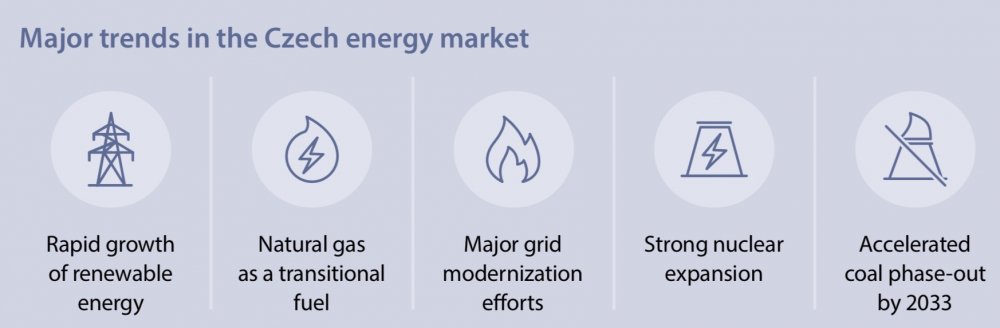
The Czech Republic is at a pivotal moment in its energy transition, moving away from a fossil fuel heavy system toward rapid and systemic change. Historically reliant on coal and nuclear power, Czechia is shifting to a low carbon model. Coal, which still accounts for about one third of power production, is being phased out by 2033. Nuclear energy remains central, representing over 40% of electricity generation and serving as the primary stable low carbon source.
Renewables are gaining ground, with solar now contributing nearly 7% and growing rapidly. The updated National Energy and Climate Plan (NECP 2024) aims to raise the share of renewables in electricity generation to 28% by 2030 and 46% by 2050. This mirrors the wider European push for decarbonisation, aligning Czech goals with EU frameworks and emissions targets.
Key government initiatives are stimulating renewable adoption, improving energy efficiency, and building long term resilience. The revised NECP, approved in December 2024, sets ambitious targets: a 55% reduction in greenhouse gases by 2030, full coal phase out by 2033, expanded nuclear development, and hydrogen investment. Support includes feed in incentives, subsidies for grid modernisation, and integration of energy storage.
Czechia's energy market operates under strong regulation, with the Energy Regulatory Office overseeing licensing, tariffs, and fair conduct. The NECP and State Energy Policy shape investment pathways for a secure, competitive, and sustainable market.
Major infrastructure projects are underway, such as EIB financed upgrades to the electricity distribution network to integrate up to 5.5 GW of new renewable capacity. Grid modernisation, including smart controls and high capacity lines, will be key as electrification surges across industry, transport, and heating, while growing data centre demand pressures system stability.
Large utilities providers like ČEZ, EPH, Sev.en Energy, and Sokolovská uhelná remain influential, especially in coal and nuclear, but a new wave of independent renewable developers and technology innovators is reshaping the market. The nuclear sector is seeing major change: South Korea's KHNP has been selected to build two new reactors at Dukovany, the largest energy investment in Czech history. By 2050, nuclear is forecast to supply 50–60% of national electricity.
Challenges persist. The rapid coal phase out must be managed to safeguard supply, especially in coal dependent areas. Gas is increasingly a transitional fuel, though its long term role is contentious due to climate goals and import reliance. Integrating intermittent renewables requires ongoing investment in grid flexibility, storage, and digital infrastructure. Rising electricity demand from transport, industry, and data centres adds further pressure on reliability.
By 2030, a more balanced mix of nuclear, renewables, and transitional gas will support climate targets. By 2050, nuclear and renewables will dominate, aided by hydrogen, advanced storage, and a modernised grid.
|
Martin Dittrich |
|